Metro Holdings (“Metro”), while being more commonly known for its departmental stores, is actually a real estate investment and development group established in 1957. Although its humble background started out with a textile store, it has now developed into a group with core businesses in – (1) Property Investment and Development and (2) Retail. The key markets that it operates in are Singapore, Indonesia, China, the UK and Australia.
Metro’s portfolio of properties is held via several methods: through direct holding of properties, through partnership with external firms, or via joint ventures with private funds. Two such funds that Metro works with are the Boustead Industrial Fund and the Daiwa House Logistics Trust. Property investment and development continue to form the bulk of Metro’s income at close to 75% as of FY23, while retail, being the more stable portfolio of Metro’s, forms the remainder.
Financial Highlights
For the full year ended 31 March 2023 (“FY23”), Metro saw its revenue rise by 16.7% year-on-year (“YoY”), from SGD 100.5m in FY22 to SGD 117.2m in FY23. Similarly, for its profit after tax, it saw a slight growth of 7.2% YoY, from SGD 23.7m in FY22 to SGD 25.3m in FY23. The improved performance primarily comes from higher retail contribution, which saw approximately a 20% rise in revenue YoY in FY23. Performance from the property investment and development segment continues to be mixed, given its diversification across key markets drawing in varied performances.
The impact of higher costs appears to be well-cushioned by Metro. Despite higher overall finance costs rising from SGD 19.2m in FY22 to SGD 26.9m in FY23, it was partially offset by higher interest income on its financial instruments, which rose from SGD 20.8m in FY22 to SGD 24.2m in FY23. Similarly, general cost savings helped to offset the rising wage costs brought about by inflation, with general and administrative expenses staying flat despite wage costs rising by approximately 14%.
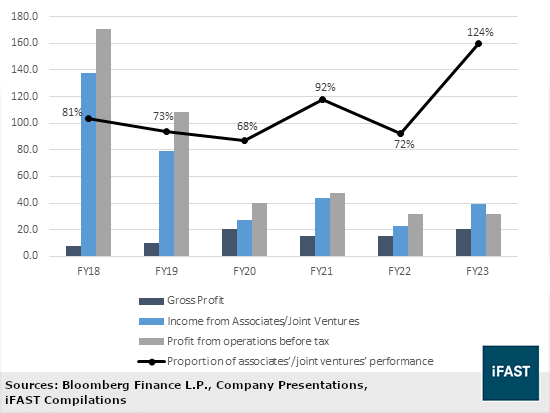
Chart 1
Metro’s past performances since FY18 (SGD m)
Similar to other companies with real estate as a core business, the income from property investment and development tends to be unstable. Looking at Metro’s past performances (Table 1), despite its retail business being able to provide a base, Metro remains heavily reliant on the real estate sector for its profits. Historically, income contributed by its associates and partners – mostly holdings that Metro does not have controlling interests over – has been a substantial proportion of Metro’s profit before taxes.
While working with many partners results in greater volatility in performance, the silver lining is that it provides for diversification and allows it to tap into more opportunities. The outlook ahead might be challenged for both the Retail and Property sectors given the still elevated inflation alongside high interest rates, but Metro’s mixed portfolio provides for the resiliency it requires during this period of uncertainty.
Liquidity and Credit Profile
Metro has a healthy credit profile, capable of cushioning further impact on interest rates. Metro’s total borrowings fell marginally from SGD 606m in FY22 to SGD 595m in FY23, with SGD 139m being short-term borrowings repayable within 1 year. All of Metro’s borrowings are unsecured, which stands out against other real estate developers who tend to have encumbered assets on borrowings. Amidst such a challenging economic environment, we like Metro’s generally low leverage on its balance sheet, in which its net gearing remains at a healthy level of 0.20x, while its net debt-to-total-assets is at a low 0.13x.
However, we would like to point out several downsides to Metro’s borrowings as well. (1) Metro’s borrowings are all on a floating rate basis. As a result, the average interest rate on borrowings has risen from 2.7% as of FY22 to 3.7% as of FY23, reflecting the impact of higher interest rates. (2) Metro has borrowings denominated in AUD (25.4%) and GBP (15.8%), with the remainder denominated in SGD. As such, beyond just interest rate risk, Metro’s borrowings are further exposed to ongoing foreign currency risks.
Metro holds a relatively prudent cash position, with cash and cash equivalents of SGD 329m – more than sufficient to repay its short-term borrowings. We feel that Metro’s ability to make interest payments from its free cash flow might be limited (given the large variance in performance from its associates and joint ventures, and therefore a large variance in dividends), but the existing cash it sits on will be able to cover the payments.
We think that Metro’s credit profile continues to be healthy and resilient, despite the lower profitability in the recent few years. It has been able to cushion the impact of rising interest rates, where we continue to see the overall credit profile to be relatively healthy. At the same time, we believe Metro will have sufficient buffer for additional impact from interest rates, should interest rates continue to rise further.
Metro has indicated within its Annual Report FY23 that it intends to defer uncommitted capital expenditure and to implement further cost savings. Given Metro’s current stance on being more disciplined and prudent with finances, it seems quite unlikely to be taking up further borrowings unless a good opportunity presents itself.
Recommendations
Table 2
SGD
fixed rate issuances of similar maturity by real estate companies
Table 3
Credit
metrics of comparable companies with Metro
|
Net Debt to Shareholders Equity (%)
|
Total Debt to Total Assets (%)
|
Cash Ratio
|
Current Ratio
|
|
METRO
|
20.31
|
27.49
|
1.65
|
3.79
|
|
CITSP
|
83.60
|
45.11
|
0.48
|
2.15
|
|
UOLSP
|
24.94
|
24.05
|
0.83
|
3.03
|
|
FPLSP
|
69.19
|
41.65
|
0.53
|
1.38
|
|
GUOLSP
|
75.83
|
42.58
|
0.53
|
2.85
|
|
OUESP
|
44.05
|
31.75
|
0.43
|
0.67
|
|
Sources: Bloomberg Finance L.P., iFAST
Compilations.
Based on their latest annual filings. Data
as of 6 September 2023.
|
Metro offers the fixed rate METRO 4.300% 02Apr2024 Corp (SGD), with a yield to maturity of 4.57% with 0.57 years to maturity left. As compared to the 6-months Singapore Treasury Bill (“T-bill”) yield at 3.71% as of 7 September 2023, it provides a relatively attractive yield pick-up with a similar tenor – a good compensation for the additional credit risk to undertake. Given the substantial cash position Metro has, we believe it is unlikely to face any issues redeeming the SGD 200m issuance.
We like Metro for its credit profile in comparison to other similar real estate companies (Table 3). With its cash and cash equivalent sitting at SGD 329m, in general, Metro’s credit metrics stand out against other companies. In addition, Metro is considerably less leveraged than the majority of other real estate companies.
With an overall healthy credit profile and higher spreads as compared to other issuances of similar maturity, we recommend the METRO 4.300% 02Apr2024 Corp (SGD). The issue will be good for investors seeking shorter tenors while looking for yields higher than the risk-free rate. Despite the challenges in the real estate sector, Metro makes up with its resilient business profile, where it remains capable of cushioning for further impacts should interest rates continue to be volatile.
Declaration: For specific disclosure, at the time of publication of this report, IFPL (via its connected and associated entities) holds a position in METRO 4.300% 02Apr2024 Corp (SGD), and the analyst who produced this report holds a NIL position in the abovementioned securities.